
Why Brushing Feels Harder in the First Trimester
For some women, one of the first changes is not obvious from the outside.
It happens quietly, in front of the mirror.
A routine that used to feel automatic suddenly feels different.
Not impossible.
Not dramatic, necessarily.
Just more uncomfortable than it used to be.
The first trimester can bring a kind of physical sensitivity that reshapes ordinary moments in unexpected ways. And brushing your teeth can become one of them.
If brushing has started to feel strangely unpleasant very early in pregnancy, you are not imagining it. The first trimester often changes the way the body experiences daily sensations, and oral care can begin to feel different before many women even have words for why.
The first trimester can change everyday routines very quickly
One of the hardest things about the first trimester is how suddenly familiar things can feel unfamiliar.
You may still be doing the same routine, in the same bathroom, with the same products. But the experience is no longer the same. What used to feel neutral now feels more noticeable. What used to feel easy now asks for more effort.
That is part of what makes the first trimester so disorienting.
It is not only that the body is changing.
It is that ordinary routines can stop feeling ordinary almost overnight.
Brushing often falls into that category.
Early pregnancy can make the mouth feel more reactive
The first trimester is often a season of heightened responsiveness.
The body may feel more alert to sensation. More sensitive to texture. More aware of small discomforts. And that shift can change how the mouth responds too.
A toothbrush may feel less neutral than before.
The mouth may feel less tolerant of pressure.
Even the simple act of brushing can feel more present, more noticeable, and less effortless.
This does not always show up as one clear symptom. Sometimes it is just a general sense that the whole experience feels less comfortable than it used to.
Discomfort often appears before there is a clear explanation
One of the frustrating things about early pregnancy is that discomfort can arrive before understanding does.
You may notice that brushing feels off before you can explain exactly what has changed. It may not be one obvious issue. It may just be a feeling that the routine has become harder to move through naturally.
That uncertainty can make the experience even more unsettling.
When there is no simple label for what feels different, it is easy to question yourself. But early pregnancy often works like that. The body begins adapting before the mind has fully caught up.
The first trimester can make small sensations feel bigger
There is a particular intensity to the first trimester.
Because so much is shifting at once, even small sensations can feel magnified. A routine that used to sit in the background can suddenly move to the foreground. Brushing is no longer just brushing. It becomes something you actively feel.
That can be surprising, especially if you have always thought of oral care as one of the easiest parts of the day.
But early pregnancy does not only affect big moments.
It can also change the feel of very small ones.
The emotional side of routine discomfort is often overlooked
When brushing becomes more uncomfortable, the effect is not only physical.
It changes the emotional tone of the routine too.
A moment that used to feel quick and forgettable can begin to carry resistance. You may find yourself pausing before you start. You may want the routine over with sooner. You may feel annoyed that something so simple no longer feels simple.
That emotional friction matters.
The first trimester already asks a lot. When even small daily rituals begin to feel more difficult, it can leave you feeling less at ease in your own rhythm.
Why early discomfort can feel so discouraging
Discomfort in the first trimester often feels discouraging because it arrives so early.
At a moment when many women are still adjusting to the idea of pregnancy itself, the body may already be asking for more patience, more flexibility, and more adaptation than expected.
That can make brushing feel like one more thing that no longer works the way it used to.
And yet, this is often exactly the moment when gentleness matters most. Not because the routine needs to become perfect, but because it needs to remain possible.
The first trimester is often a season of adaptation
This is the deeper truth behind the discomfort.
The first trimester is not always a time when routines need to be rebuilt completely. But it is often a time when they need to soften.
That might mean changing the pace of brushing.
It might mean changing what “manageable” looks like for a while.
It might mean accepting that a routine can still be meaningful even when it no longer feels effortless.
This is not about giving up structure.
It is about allowing care to adapt to a body in transition.
A gentler experience can help protect the routine
When brushing becomes more uncomfortable, what matters most is often not intensity. It is maintainability.
A routine that feels softer and less abrasive is easier to keep returning to. A routine that feels demanding or unpleasant is harder to sustain, especially in a trimester already shaped by fatigue, sensitivity, and constant physical change.
That is why comfort is not a minor detail.
It is often what protects consistency.
And consistency, even in a gentler form, matters.
The Dentine Care view
At Dentine Care, we believe early pregnancy deserves a softer kind of support.
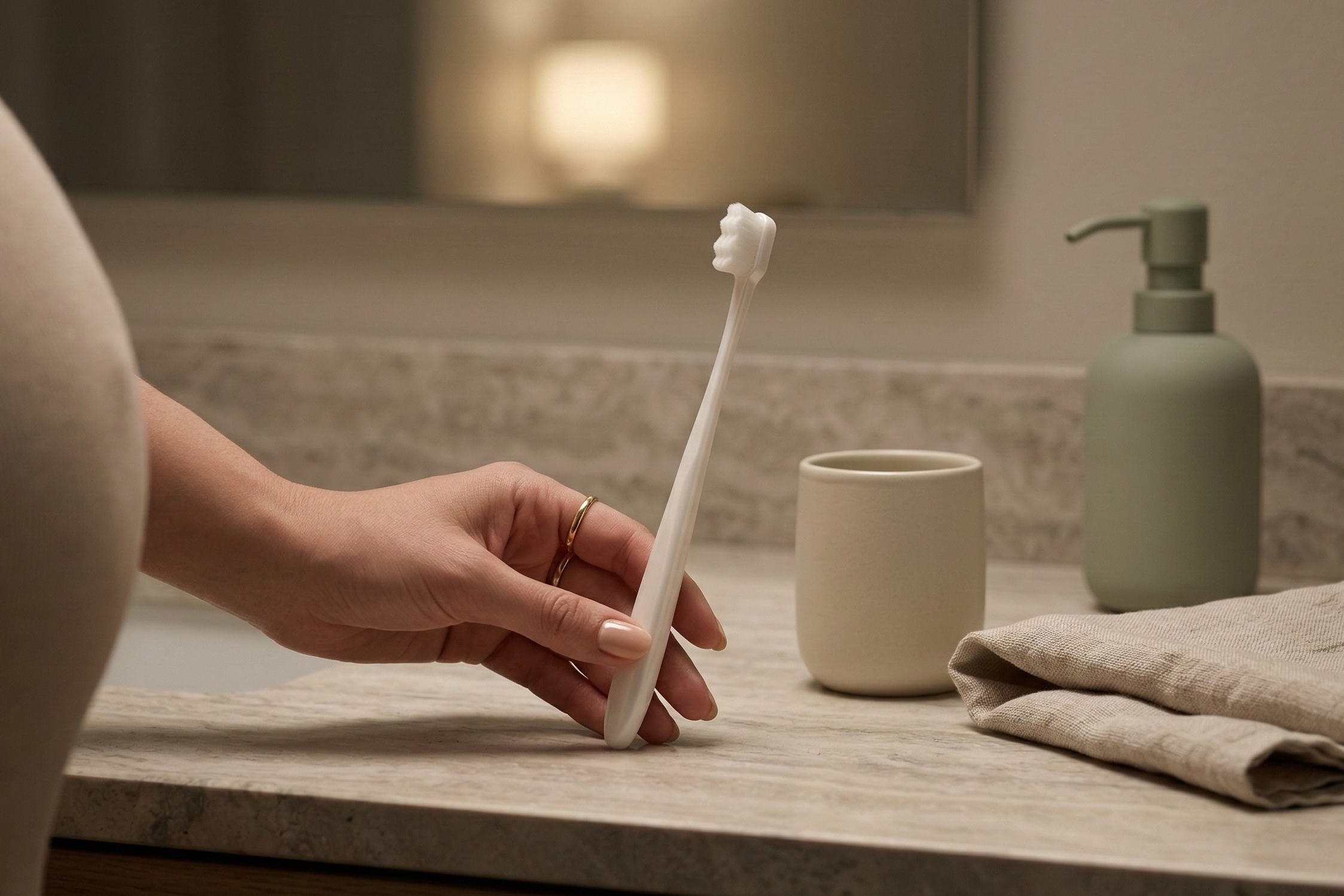
The first trimester can make familiar routines feel unexpectedly different, which is why oral care should feel more gentle, more reassuring, and easier to return to during that season of change. That is also why we offer the Mommy Brush, made to bring a softer brushing experience to moments when the mouth feels more delicate than usual.
When sensitivity changes, care should change too.